Is Sri Sri Ravi Shankar Anti Muslim? Exploring His Work for Harmony Across Faiths
A Life Dedicated to Peace, Service, and Social Transformation
Sri Sri Ravi Shankar (born 13 May 1956, Papanasam, Tamil Nadu) is an Indian spiritual leader and humanitarian recognized globally for his work in meditation, stress-relief techniques, and social service initiatives. Revered by followers as “Gurudev,” he has devoted his life to promoting inner peace, interfaith harmony, and community development across continents.
He is the founder of the Art of Living Foundation (1981), an international non-governmental organization operating in more than 180 countries. Through structured programs combining breathwork, meditation, yoga, and practical wisdom, his movement seeks to build what he describes as a “stress-free mind and a violence-free society.”
Early Life and Spiritual Foundations
Sri Sri Ravi Shankar was born to Vishalakshi Ratnam and R.S. Venkat Ratnam. The name “Ravi” (sun) reflects his Sunday birth, and “Shankar” references Adi Shankaracharya, the 8th-century Hindu philosopher whose birth anniversary coincided with his.
From childhood, he reportedly displayed deep interest in spirituality and philosophical inquiry. One of his early influences was Sudhakar Chaturvedi, a respected Vedic scholar and associate of Mahatma Gandhi, who helped shape his understanding of scripture and discipline.
He later earned a degree in Physics from St. Joseph’s College, Bangalore (1973). During the mid-1970s, he worked closely with Maharishi Mahesh Yogi, founder of Transcendental Meditation (TM), assisting in organizing conferences and expanding awareness of Vedic knowledge systems globally.
The Emergence of Sudarshan Kriya
In 1982, after a ten-day period of silence near the Bhadra River in Karnataka, Sri Sri Ravi Shankar introduced Sudarshan Kriya — a rhythmic breathing technique designed to reduce stress and promote mental clarity.
The technique became the cornerstone of the Art of Living programs. Practitioners report improvements in emotional stability, resilience, and overall well-being. Over time, Sudarshan Kriya has been taught to millions worldwide through structured courses.
The Art of Living Foundation
Founded in 1981, the Art of Living Foundation grew from a small spiritual initiative into a global volunteer-driven movement.
Vision
The organization’s guiding philosophy emphasizes that sustainable peace begins at the individual level. It advocates mental well-being as the foundation for social harmony.
Global Presence
- Active in 180+ countries
- Accredited with consultative status at the United Nations (since 1996)
- Volunteer-led operations across education, health, and rural development
Core Programs
- Meditation and breathwork courses
- Youth empowerment initiatives
- Prison rehabilitation programs
- Trauma relief workshops
- Leadership and personal development programs
Most instructors operate on a volunteer basis, reflecting the foundation’s service-oriented structure.
Humanitarian and Environmental Initiatives
Beyond spiritual instruction, the organization has undertaken various development and ecological projects:
Rural Development
Programs supporting sustainable farming practices in regions such as Maharashtra and Andhra Pradesh.
Environmental Restoration
River rejuvenation initiatives, including work on rivers such as:
- Kumudavathi
- Palar
- Manjra
- Vedavathi
Afforestation
“Mission Green Earth” initiative aimed at planting millions of trees globally.
Disaster Relief
Rapid-response volunteer mobilization during floods, earthquakes, and other humanitarian crises.
Civic Engagement
Volunteer For a Better India (VFABI) campaigns promoting community service, health camps, and civic responsibility.
These initiatives contribute to the foundation’s public profile as both a spiritual and service-based institution.
Sri Sri Ravi Shankar and His Engagement with Muslim Communities
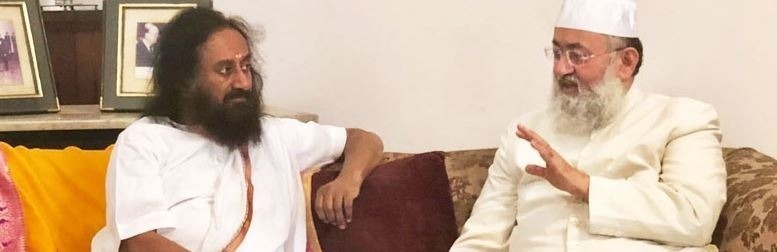
Sri Sri Ravi Shankar has repeatedly emphasized that spirituality goes beyond religious identity and that all faiths share common human values such as compassion, prayer, service, and devotion to God. Over the years, he has participated in interfaith conferences and dialogues where Muslim scholars, clerics, and community representatives were present. His approach in these forums has focused on building trust, encouraging peaceful coexistence, and promoting mutual respect between communities.
Interfaith Dialogue and Peacebuilding
Through the Art of Living Foundation, he has supported peace dialogues in sensitive regions and has encouraged communication between religious groups during periods of tension. In public statements, he has acknowledged the spiritual depth of Islamic traditions and has often said that extremism should not be confused with religion. His position consistently stresses that violence carried out in the name of faith contradicts the essence of all religions, including Islam.
Humanitarian Programs Serving All Communities
The foundation’s humanitarian initiatives operate without religious distinction. In areas with significant Muslim populations—both in India and internationally—programs such as trauma relief workshops, disaster response efforts, and youth leadership training have included Muslim participants.
Examples of outreach include:
- Prison rehabilitation programs, where inmates from all religious backgrounds, including Muslims, participate in breathing and meditation workshops aimed at reducing aggression and stress.
- Disaster relief operations in flood- and conflict-affected regions, where aid is distributed based on need, not religious identity.
- Free education and rural development projects, benefiting underprivileged families across communities.
Promoting Harmony in Public Discourse
During periods of social or political debate, Sri Sri Ravi Shankar has called for calm and dialogue rather than confrontation. He has stated that labeling entire communities negatively harms national unity. His speeches often reinforce the idea that India’s strength lies in its diversity and that cooperation among Hindus, Muslims, Christians, Sikhs, and others is essential for long-term peace.
A Values-Based Approach
At the core of his engagement with Muslim communities is a broader philosophy:
- Respect for all faith traditions
- Encouragement of prayer and devotion in one’s own religion
- Dialogue instead of polarization
- Service as a common ground for unity
Rather than positioning spirituality in opposition to any religion, his approach frames it as a shared human experience. Through interfaith conversations and inclusive humanitarian work, his initiatives have aimed to foster understanding and reduce mistrust between communities.
Public Narratives and Interfaith Engagement
In recent years, some online discussions have circulated the phrase “Sri Sri Ravi Shankar Anti Muslim,” influencing public perception. However, accounts from individuals who have interacted directly with him present a more nuanced perspective.
Visitors and religious scholars who have met him and observed the ashram’s activities firsthand have, in various instances, stated that public narratives circulating online do not necessarily reflect their personal experiences. They have encouraged direct dialogue and personal interaction as ways to dispel misconceptions and strengthen mutual understanding across faiths.
Philosophy and Teaching Approach
Sri Sri Ravi Shankar’s teachings integrate ancient Indian wisdom traditions with contemporary life challenges. Key themes include:
- The power of breath in emotional regulation
- The importance of meditation for mental clarity
- Service (Seva) as a path to fulfillment
- Interfaith harmony and universal values
- Stress management in modern society
His approach emphasizes practicality — spiritual insight applied to daily life.
Legacy and Continuing Influence
Over four decades, Sri Sri Ravi Shankar has influenced millions through structured programs, public talks, and volunteer networks. His model combines:
- Personal transformation
- Community engagement
- Environmental stewardship
- Global humanitarian outreach
While public debate occasionally surrounds large institutions, the scale and longevity of the Art of Living Foundation reflect sustained global engagement.
Conclusion
Sri Sri Ravi Shankar’s life represents the intersection of spiritual practice and social action. From the development of Sudarshan Kriya to global humanitarian initiatives, his work centers on the belief that inner transformation leads to societal change.
His legacy continues to evolve through a worldwide volunteer movement focused on mental well-being, social harmony, and service-oriented leadership.
Post a comment