Reclaiming Bodh Gaya: A New Chapter in Buddhist Assertion
Introduction
The recent controversy at the Mahabodhi Mahavihara in Bodh Gaya has reignited a long-standing debate over religious control and heritage rights. What appeared to be a ceremonial observance on Buddha Purnima has instead drawn national attention to a deeper conflict over governance, identity, and historical ownership at one of Buddhism’s holiest sites.
This episode reflects not merely a political misstep, but a broader and centuries-old religious contestation over Bodh Gaya’s sacred landscape.
What Sparked the Latest Controversy?
On 12 May, during Buddha Purnima celebrations, Bihar’s Governor attended a ceremony at the Mahabodhi Mahavihara as the chief guest. A widely circulated video showed him being guided in Hindu prayer rituals inside the temple’s inner sanctum.
While some observers interpreted the event as a gesture of syncretism, critics viewed it as symbolic of state indifference toward an ongoing Buddhist protest taking place just two kilometres away.
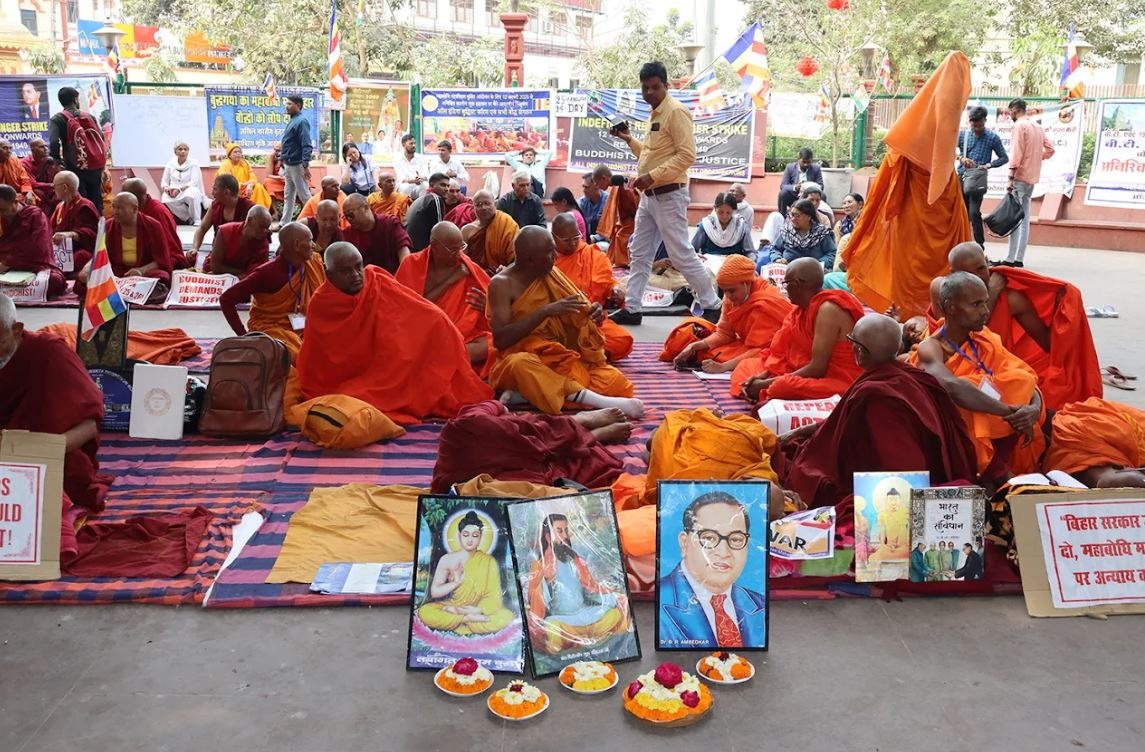
For nearly three months prior, Buddhist monks had staged a hunger strike within the temple complex, demanding the repeal of the Bodh Gaya Temple Act, 1949. Authorities evicted them on 27 February, after which the protest shifted to government land on Domuhan Road in Gaya.
The Bodh Gaya Temple Act, 1949: Core of the Dispute
The Bodh Gaya Temple Act established the Bodhgaya Temple Management Committee (BTMC), the administrative body responsible for managing the Mahabodhi Mahavihara.
Composition of the BTMC:
- Eight members nominated by the Bihar government
- Four Hindus
- Four Buddhists
- Chaired by the district magistrate
Protesters argue that this arrangement is fundamentally unjust. According to Buddhist leaders spearheading the movement, adherents of every major religion in India control their own sacred institutions—except Buddhists at Bodh Gaya, the site of the Buddha’s enlightenment.
The demand is clear: full administrative control of the Mahabodhi temple must rest exclusively with Buddhists.
A Site of Religious Contestation Through History
The dispute over Bodh Gaya is not new. Historians have long described it as a site of layered religious appropriation and reinterpretation.
Hindu Claims and Historical Layers
Hindu tradition associates Bodh Gaya with episodes from the Ramayana and longstanding practices such as pind daan (ancestral rites). Medieval Puranic texts also describe the site as spiritually significant for ancestral rituals.
Historical accounts note that in the mid-eleventh century, parts of the site were reused to establish a Vishnu temple. However, the present-day Vishnupada Temple—where pind daan is widely performed—was constructed in the eighteenth century by Ahilyabai Holkar.
Importantly, Buddhist leaders have clarified that they do not oppose Hindu rituals conducted at Vishnupada Temple. Their objection is limited strictly to administrative control of the Mahabodhi Mahavihara.
Why the Protest Matters Now
Several factors make this moment significant:
1. Renewed Buddhist Assertion
The movement represents a more vocal and organized assertion of Buddhist identity in India, especially among communities that see Bodh Gaya as central to their religious and cultural heritage.
2. Governance and Secularism Debate
The controversy raises larger constitutional questions:
- Should a secular state directly manage religious institutions?
- Is equal representation sufficient when a site holds exclusive spiritual significance for one community?
3. Global Buddhist Attention
Bodh Gaya is not merely an Indian monument—it is a global pilgrimage destination for Buddhists from Sri Lanka, Thailand, Japan, Myanmar, Bhutan, and beyond. Administrative control therefore carries international symbolic weight.
The Broader Legal and Political Implications
Repealing or amending the Bodh Gaya Temple Act would require legislative action. Such a move could also trigger wider debates about state control over religious institutions across India, including Hindu temples managed by government boards in several states.
Thus, the issue extends beyond Bodh Gaya—it touches upon the evolving relationship between religion, heritage, and state authority in modern India.
Conclusion
The events at Mahabodhi Mahavihara are not isolated incidents. They represent a fresh chapter in a centuries-old contest over one of the world’s most sacred Buddhist sites.
For protesters, the issue is not ritual participation or interfaith symbolism. It is about custodianship, identity, and religious autonomy. Whether the government chooses dialogue, reform, or status quo will determine how this new phase of Buddhist assertion shapes India’s religious and constitutional landscape.
Post a comment